The Isle Fincara Trilogy
The island of Fincara, or Finchaighe, exists in Irish myth, fated to be cast beneath the waves by druidical spell, where one day a deep-diving hero steals a cooking-spit from the island's stalwart ladies.
...the Gaelic tales abound in allusions to a beautiful country situated under the sea – an enchanted land sunk at some remote time and still held under spell. In some romantic writings it is called Tír-fa-tonn, ‘the land beneath the wave’; and occasionally one or more of the heroes find their way to it . . . The island of Fincara and the beautiful country seen beneath the waves by Máel Dúin are remnants of the same superstition. PW Joyce
Using the conventions of the portal fantasy and a parallel world, my Island has a different fate. Out beyond the Western Isles, in the ocean we call the Atlantic and still on the surface, an unwitting time-traveller from our own day arrives.
The Seaborne —“a parable for our torn times”
Damian Walford-Davies
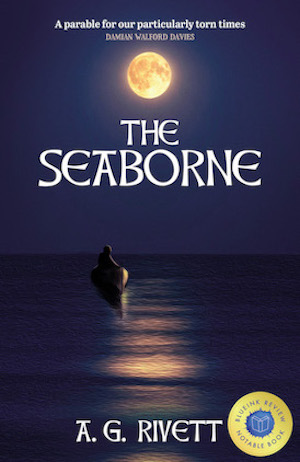
When the idea for The Seaborne first came to me, I was like John: imagining how, were I to be in his situation, I might impress the locals. By the time I came to write the book - and in large measure, as a result of writing it - other considerations pressed upon me. I now see it as a meditation on the multiple impacts of technology in the world. Technology has revolutionised society, bringing myriad changes we have welcomed as benefits. It has also brought the Bomb and nuclear waste, taken people off the land and into the cities, and created the circumstances for the complex of environmental crises now faced by us all, displacing people and augmenting refugee numbers.
The Seaborne is a down-to-earth Fantasy fiction, set on an imaginary Celtic Island a thousand years ago and a world away. I say ‘down-to-earth’ because, once you have accepted the altered time and place, the realities of the Island world dictate the possibilities open to the characters. It is a ‘portal fantasy’ - a story where the main character is transported into another existence. C S Lewis' Narnia books are classic examples. So is Philip Pullman's Northern Lights trilogy. Both these writers have succeeded in making their alternative worlds convincing, and I was particularly pleased when a reader wrote: It is notoriously difficult to create an internally consistent and convincing alternative universe - something I think Rivett has achieved magnificently.
The Seaborne is about a man from our own times, John Finlay, whose London engineering business fails. In panic he runs away to Scotland and arrives on the quay at Mallaig, looking for work as a deck-hand on a deep-sea fishing boat. The next picture we have is from the perspective of a raven, soaring above a sea-coast, watching a small boat coming to land. Then we're into the viewpoint of one of the fishermen, Dermot, bringing ashore a body found at sea.
By the time we're in John's mind again, he's hallucinating. Only when the fever that followed his ordeal has left him do we accompany him through his dawning realisation that he has not, as he thought, been washed up on some Hebridean shore. His surroundings look medieval. They're clearly pre-industrial. The boats have sails, not engines. The round houses have thatched roofs, and no chimneys. There are no vapour-trails in the sky. People are amazed at the zips on his clothes. This is not a Scottish island in ordinary time.
The Priest’s Wife —“a work of great beauty and imagination”
Rolf Billes, Iona Community
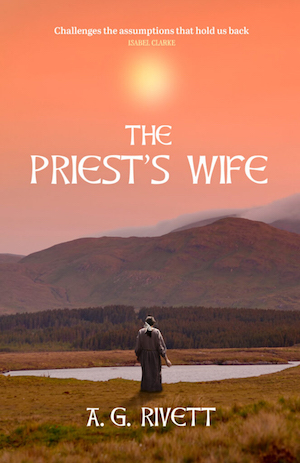
While writing The Seaborne I became acutely aware of the patriarchal character of the society John Finlay was thrown into. Shinane tried to stand up to it but, so far, her scope is limited. I felt the need for a strong woman to break through. Then Morag suggested herself, and I sat down and started writing. I don't think what book to write. Rather, books suggest themselves, and I sit down and tap the keys. In writing about Morag I drew on my own experience of depression, when I felt at an impasse. I remembered the help I experienced from a wider circle that enabled me to break through.
In writing about Father Aidan I have drawn on what I have witnessed of intolerance and the hand of an authority that seeks to wield power and control over people's lives, crushing them. Shareg Micheil, who was as patriarchal in his outlook as anyone when the Trilogy began, shows his quality in being willing to ‘think outside the box’ and find, through Morag, a way to sidestep that iron hand.
The story is presaged by the visit of a wandering vagrant, Gormagh, who confronts Morag:
‘You!’ His eyes were wide, the whites bloodshot. ‘Do you not know who you are?’ … ‘Who was it gave you birth? It was she, was it not? She! She!’
The question disturbs her. She never knew her mother; she is haunted by taunts that echo in her mind from childhood: Who's your mother? Don’t you know?
Morag has lived with this unknowing all her life.
But as Hugh sickens, then dies, so her position in the community crumbles. She must set out to find the answer to Gormagh's question, and find herself anew.
Her quest takes her first to Kimmoil, where she grew up. Arriving in the hungry quarter of the year, she has a cool reception from the shareg (headman) and an enigmatic answer from the town's keeper of records.
Meanwhile Father Aidan has come as Hugh's replacement. Unlike Hugh and the old archpriest, Aidan is intolerant of the blend of Druidical myth and Christian story that has nourished the Islanders. Indeed, he is under instruction from the new archpriest to destroy it and bring in its place a more patriarchal creed.
Two people: a priest's widow and a priest, linked by role yet spiritually poles apart. And both must find the place in the community where they belong.
‘So it's come, Antie.’ Morag looked at Sorcha sharply. ‘What?’ ‘Yer time. Ye'll be needed, don't ye ken?’
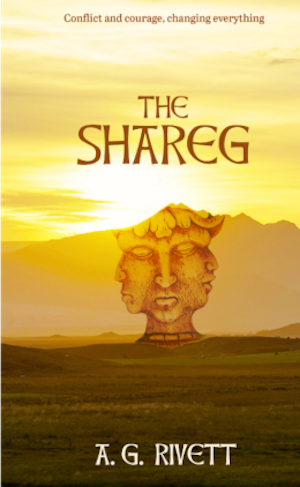
The Shareg
The Shareg completes the cycle of the Isle Fincara Trilogy. Like The Seaborne, the first book, it begins with a prologue in our own world, before moving to another time and place, and the island of Fincara. Here a second prologue brings us up to date with the political situation. For the storm hinted at in Book II, The Priest's Wife, is about to break.
Three stories have been running through the Trilogy. One is obvious: that of John/Dhion, the man from our own times who wakes into a society that challenges his authenticity. His story must be brought full circle. Dhion took a back seat in The Priest's Wife, but now he returns to centre stage, facing his own sense of self-doubt as a stranger, a foreigner. And where must his priorities lie: with family, or with town?
The second theme was developed in The Priest's Wife, Morag's story. Yet her winning through brought a tension that has yet to be resolved. The shareg and the archpriest represent the poles of a classical medieval church-versus-state power struggle. It culminates in imprisonment, ends in war.
And the third line? When I was developing the character of Shinane in The Seaborne I left an enigmatic hole in her psyche. We saw it in her longing to learn to read, and again in her ‘mountain-top’ experience; in the small voice inside her: your gift is something rarer, something still hidden. The last book follows this line, reaching its fulfilment in the final chapters.
Throughout the book the figure of Sorcha is our link with the Guardians, the hidden circle of adepts who bring a spiritual depth, and remind us of our place on the earth with all its other creatures.
The epilogue rounds off the story from our world's point of view, for that which cometh forth must return. But the story must also be completed in Fincara's world, and a second epilogue flashes to us a picture of Shinane's children in old age, and where their world is heading.
A book that draws inspiration from the Western Isles and Celtic Christian spirituality, The Shareg, the final book of my Isle Fincara Trilogy, will be launched at the Iona Community Shop on Thursday October 8th 2026, ahead of the Iona Festival of Writing and Storytelling.